
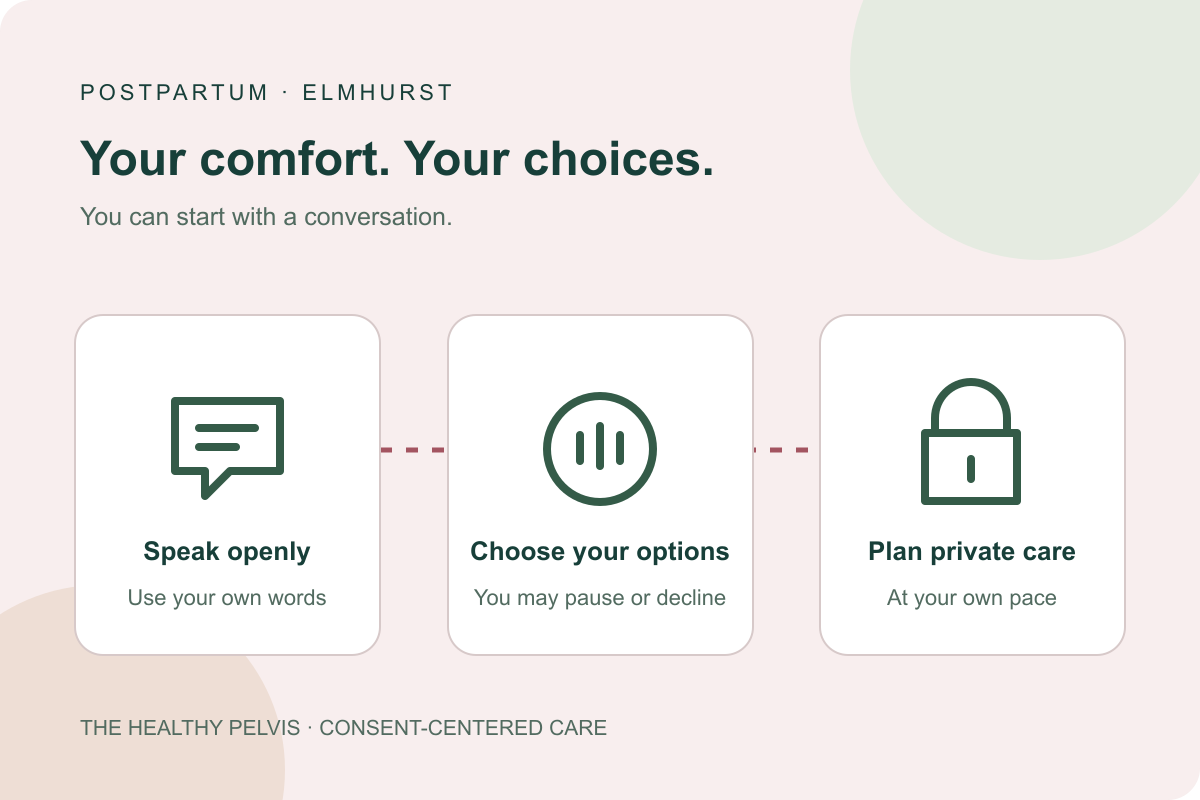
If intimacy hurts after childbirth, you deserve a conversation that takes the discomfort seriously. You do not need to push through pain, meet a deadline or already know its cause before asking for help. This guide explains questions to bring to your OB/GYN and what private pelvic floor care in Elmhurst can involve.
Comfort, choice and medical evaluation come first. A postpartum checkup does not create an obligation to resume sex, and this article is not clearance to do so.
Start with a medical conversation
Pain after birth can have different contributors. Healing tissues, dryness and pelvic floor muscle function are among the topics a medical professional may assess. Symptoms do not reveal which factor is responsible, and physical therapy is not a substitute for gynecologic evaluation.
Tell your OB/GYN about persistent pain or other changes rather than assuming they are an unavoidable part of parenthood. Ask about healing, possible infection or irritation and whether pelvic floor PT is appropriate. Medication or hormone treatment decisions belong with your medical provider.
What can I say if it feels embarrassing?
You can start with a sentence such as: ‘Since giving birth, intimacy hurts, and I want help understanding what is happening.’ It is enough to describe your concern in your own words. You may write it down if that makes the appointment easier.
Useful details include whether discomfort is at the opening or deeper, whether it happens during or afterward and whether tampon use, an examination or other activities are also uncomfortable. These are conversation prompts, not a way to diagnose yourself.
You can also say what you do not want to discuss or attempt today. Bringing a support person is your choice; you do not need a partner present to ask for care.
Where pelvic floor physical therapy fits
When a medical assessment supports it, PT may address movement and muscle-related contributors to discomfort. The Healthy Pelvis’s pain-with-intimacy service includes consent-centered assessment and individualized options rather than an automatic strengthening program.
A therapist may ask about symptoms, birth history, scars, breathing, movement and your goals. Ask how the proposed care relates to what was found in your evaluation. A plan should explain what PT can address, what needs another clinician and how progress will be discussed.
This guide does not recommend internal self-treatment, a dilator purchase or a set of Kegels. Those decisions require guidance suited to your circumstances.
An internal examination is a choice—not an entry requirement
Before any suggested examination, ask what it involves, why it may be useful and what alternatives exist. At The Healthy Pelvis, an internal assessment is optional. You may decline, pause or stop, including after initially agreeing.
You can request a visit focused on conversation and external assessment options. Ask what can be learned that way and what limits there may be. Consent is ongoing; tolerating a painful procedure is not the goal of treatment.
If you want to discuss previous experiences that affect your comfort, do so privately with your clinician. You do not need to disclose personal details in a public form or review.
Planning a private visit in Elmhurst
An in-home appointment removes the clinic commute and lets you choose a setting that feels private. The Healthy Pelvis serves Elmhurst and nearby western suburbs. Confirm your location and current availability through the practice, not through a public comment.
Discuss who will be home, which room feels comfortable and whether you need feeding or childcare arrangements. A home visit still needs privacy and a practical plan; confirm the space and appointment length in advance.
The free 15-minute phone consultation lets you ask about services and logistics. It is not a physical examination or a determination of the cause of pain.
Five questions for your first appointment
A short question list can keep a sensitive conversation focused on your priorities. You do not have to cover everything in one visit.
- Has my healing been assessed, and should I see my OB/GYN first?
- What parts of this concern may fit physical therapy?
- What can we assess without an internal examination?
- How will you explain the options and get my consent?
- How will we decide whether another medical professional is needed?
Symptoms that should not wait for PT
Seek prompt medical advice for new or worsening pain or concerning symptoms. Urgent postpartum warning signs—including heavy bleeding, fever, severe abdominal pain, chest pain or trouble breathing—need immediate medical attention. Tell the medical team you recently gave birth. Call 911 for an emergency.
Do not use a routine consultation as the next step for a suspected infection or an urgent postpartum problem.
Insurance and the next step
The Healthy Pelvis accepts Blue Cross Blue Shield (BCBS) PPO only. Coverage, referral requirements and patient responsibility depend on your exact plan. Verify eligibility rather than assuming every BCBS product is accepted or that a visit will be paid in full.
If you have another plan, ask about current self-pay options. Benefit verification is not a guarantee of payment. You can begin with the existing free phone consultation to ask about private care, with no clinic trip required.
Common questions
Do I have to wait for a particular date to ask questions?
No. You can ask about planning and symptoms at any point. Your medical team’s guidance and your recovery determine when assessment or treatment is appropriate.
Is pain after a C-section also worth discussing?
Yes. The birth method does not rule out postpartum concerns. Discuss pain with your medical provider and ask what type of assessment fits your symptoms.
Will I be told to do more Kegels?
Not automatically. The plan should follow assessment rather than assume every concern needs strengthening.
Can I stop an assessment after it begins?
Yes. You can pause, stop, decline or ask for an alternative. Your goals and comfort remain part of every decision.
Sources and further reading
Medical background is drawn from the resources below. Practice information describes The Healthy Pelvis’s services; it is not a claim of guaranteed results.
Find the next page that fits your concern
Consent-centered care for pain with intimacy Postpartum pelvic floor therapy What to expect from an Elmhurst home visit BCBS PPO only: insurance and cost questionsA conversation before a commitment
Ask about private care at home.
Talk with Melissa about services and current availability in Elmhurst. The free phone consultation is separate from an evaluation or treatment visit.
Educational information from The Healthy Pelvis, not a diagnosis, medical clearance or individualized treatment advice. Seek medical assessment when appropriate. Your medical team’s guidance and your physical therapy evaluation determine your care.