
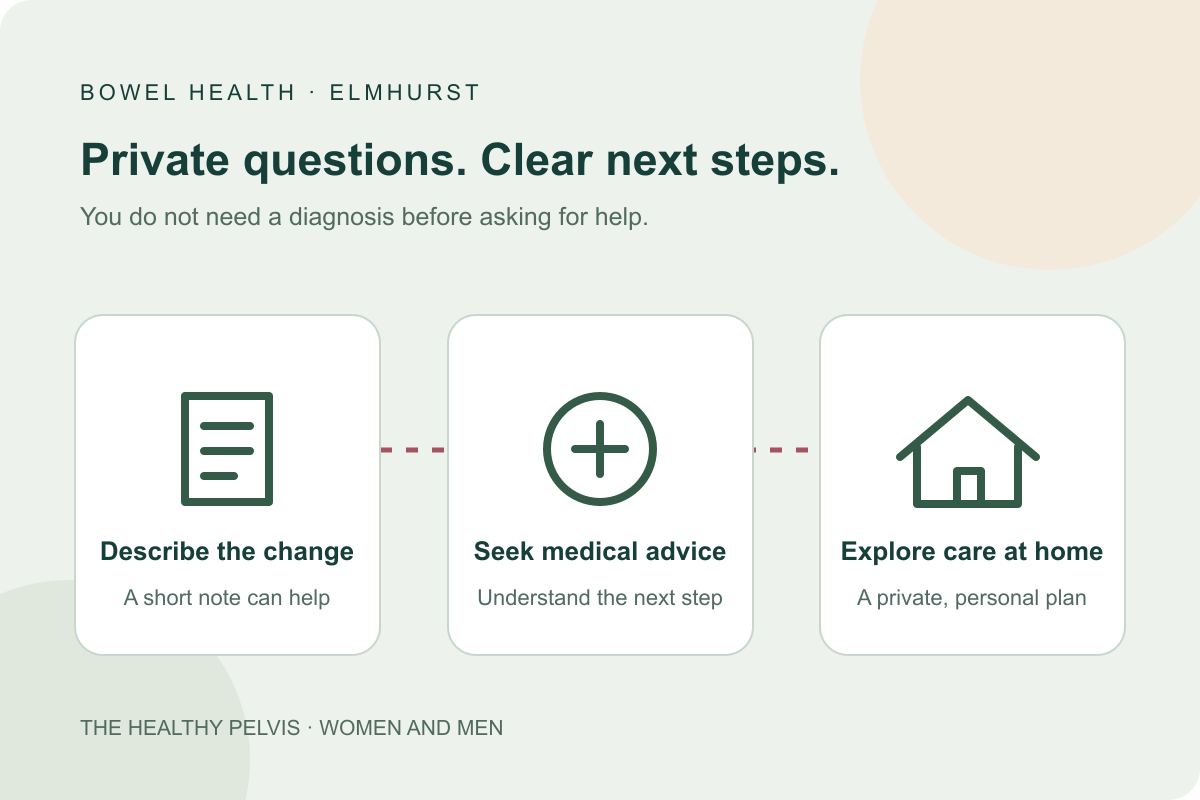
An accident, staining or a sudden urge you cannot control can affect more than the bathroom routine. It may change how you plan work, exercise or time away from home. If you are in Elmhurst and unsure where to start, a medical conversation is important; pelvic floor PT may be one part of the care plan.
Bowel leakage has different possible causes. See a medical professional rather than assuming weak pelvic floor muscles are the only explanation.
What is accidental bowel leakage?
Accidental bowel leakage, also called fecal incontinence, means passing stool or mucus without intending to. Some people notice urgency before an accident; others notice leakage without warning. Describe your own pattern to a medical professional rather than trying to assign a type yourself.
This is not simply a hygiene issue or a personal failure. A change worth discussing can be small and still affect your confidence. You do not need to wait for repeated large accidents to bring it up.
Why medical evaluation matters
The NIDDK recommends seeing a doctor as the first step. Stool consistency, constipation or diarrhea, muscle or nerve problems and other conditions can contribute. Your medical clinician can assess the cause and decide whether tests or other specialists are needed.
Ask whether a pelvic floor assessment could complement the medical plan. PT does not replace evaluation of bowel disease, prescribe bowel medication or guarantee that leakage will resolve. If bowel symptoms began after childbirth or surgery, share that history with your medical team.
How to start the conversation
Try a plain statement: ‘I am having bowel leakage, and it is affecting what I feel comfortable doing.’ You can also say that the topic feels difficult to discuss. A clinician does not need a polished explanation to understand that you want help.
If useful, bring a brief note with the pattern you notice. Do not make major dietary or medication changes to prepare for the appointment unless your medical provider advises them. Keep personal details in the private clinical conversation rather than posting them online.
- When did the change begin, and how often does it happen?
- Do you have an urge beforehand, or notice leakage afterward?
- Have stool consistency, constipation or diarrhea changed?
- What medicines, surgery, childbirth history or prior medical guidance may be relevant?
- What activity are you avoiding because of the symptoms?
What pelvic floor therapy may address
An individualized PT plan may address muscle function, coordination and bowel routines when those factors are relevant. The NIDDK describes pelvic floor training and biofeedback among treatment options. Not every technique is offered by every practice or appropriate for every person; ask what your recommended care would include.
At The Healthy Pelvis, bowel-dysfunction care includes assessment of symptoms and routines, movement and consent-based examination choices. Ask which findings support the proposed plan and how it will work alongside your medical care.
Strengthening is not a universal answer. This guide does not prescribe Kegels, recommend a device or tell you to change fiber, fluids or medicines. Those steps should be discussed with the appropriate clinician.
What a private home visit in Elmhurst can look like
The appointment starts with your history, concerns and goals. A home setting can make it easier to discuss the routines or physical tasks that matter to you without arranging a clinic commute. Confirm a private room and the space needed before scheduling.
Any internal assessment is explained and optional. Ask about external alternatives and what information each approach can provide. You can decline or stop an assessment at any time.
Home visits are subject to location and availability. Share your address privately through the practice’s scheduling process. The free 15-minute phone consultation can clarify whether THP’s services are a reasonable next step; it does not diagnose the cause of leakage.
Questions that help you compare care options
A useful plan should explain the clinician’s role and how decisions will be made. These questions can help you avoid purchasing a generic program before understanding your situation.
- Should I see my primary care clinician, GI specialist or another clinician first?
- What does your bowel-symptom evaluation include?
- What examination choices do I have?
- Which recommended techniques are actually available through this practice?
- How will we track whether the plan is helping, and when should I return to my medical clinician?
When to seek medical help promptly
Seek urgent medical advice for black or dark-red stool or bloody diarrhea. New bowel changes that persist also deserve medical assessment, even when you are considering PT. Do not wait for a routine consultation if you have severe symptoms or feel acutely unwell.
A therapy visit is not emergency care. Call 911 for a medical emergency. Your clinician can direct the next step for your symptoms.
Insurance, self-pay questions and getting started
The Healthy Pelvis accepts Blue Cross Blue Shield (BCBS) PPO only. Your exact plan determines eligibility, cost sharing and any referral or authorization requirements. Benefit verification is not a guarantee of payment.
If you have another insurance plan, ask about current self-pay arrangements rather than assuming it is accepted. The free phone consultation and a treatment appointment are separate. You can ask about care without committing to a course of therapy.
Common questions
Can I ask about care if the leakage is only occasional?
Yes. Explain the pattern and its effect on your life to your medical clinician. Frequency alone does not determine the cause or the right treatment.
Is this the same as constipation?
No. They are different symptoms, although they can occur together. Tell your clinician about both so the evaluation considers the full picture.
Is pelvic floor therapy only for women?
No. The Healthy Pelvis provides pelvic floor care for women and men. Ask whether your particular bowel concerns fit the services offered.
Will I have to agree to an internal examination?
No. Ask about the options, why an assessment is proposed and what can be learned without it. You may decline, pause or stop.
Sources and further reading
Medical background is drawn from the resources below. Practice information describes The Healthy Pelvis’s services; it is not a claim of guaranteed results.
Find the next page that fits your concern
Bowel dysfunction pelvic floor therapy Constipation and pelvic floor coordination In-home care in Elmhurst BCBS PPO only: insurance and cost questionsA conversation before a commitment
Ask about private care at home.
Talk with Melissa about services and current availability in Elmhurst. The free phone consultation is separate from an evaluation or treatment visit.
Educational information from The Healthy Pelvis, not a diagnosis, medical clearance or individualized treatment advice. Seek medical assessment when appropriate. Your medical team’s guidance and your physical therapy evaluation determine your care.